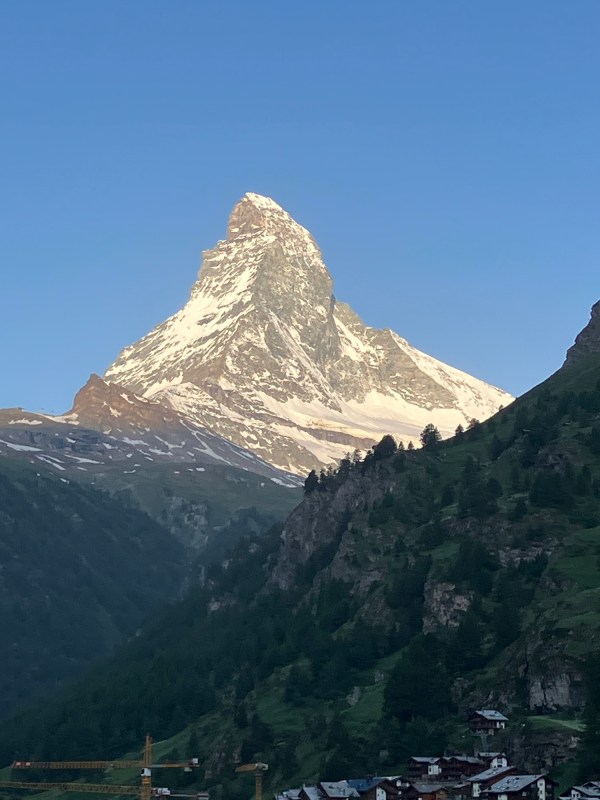
In Zermatt, I am surrounded by mountains, which I believe exert a magnetism for the particularly deranged. “I choose to climb” is carved on a gravestone in the graveyard next to the Parish church of Saint Mauritius in Zermatt. This particular one an American, “Donald Stephen Williams. New York City. 19 May 1958. 23 July 1975. On Breithorn.” An ice axe and a short length of rope are fastened to the stone. He was 18 years old. Only people who died on the Matterhorn are interred in the graveyard.
It’s different in the mountains and it’s my belief that one’s environment has a strong effect upon personality. Whatever “energies” mountains exert, they are literally awesome and in some regard act as a break upon the rampant expression of ego in the same way as the night sky used to act before it was largely washed out by industrial light starting in the late 1950’s. People are impelled to consider their own existence in relation to what they have trouble comprehending.
The Golden Age of Alpinism, in which a number of “first ascents” were achieved in the Alps in the decade ending 1865 interest me. I wonder why, in that era especially and continually ever since, privileged young bucks were/are impelled to climb. Was it Jung or Freud, one of the early alienists I think, who pointed out how risky it is for one with an unfocused mind to partake in mountain climbing. The rock becomes your whole world; it’s texture, color, aroma, its shape fill your consciousness. One misstep… Aleister Crowley 1875-1947, the great magician and alchemist was also a passionate Alpinist. He believed in a rigorous and unsentimental approach to a sport which is fraught with risk, he trained under Oscar Eckenstein, a pioneer of modern climbing techniques. He climbed in the Himalayas, the Alps, the Scottish Highlands, often seeking routes that were considered too dangerous or ambitious for the time. He was found to be abrasive, anti-authoritarian and his reputation for occult matters were deeply distressing to the broadly conservative and quite suspicious climbing community. No wonder he was an important figure in my coming of age.
Most of the graves at Saint Mauritius Church are commemorating 18-32 years olds. I found it quite moving after reading of Edward Whymper’s party of 1865. Only three survived of the party of seven, Edward Whymper, a wood engraver and artist from London, Peter Taugwelder 45 at the time who was a local guide, and his son, also Peter Taugwalder. The four who fell were Michel Croz 35, an experienced mountaineer from Chamonix, Lord Francis Douglas 18, scion of the British landed gentry and a novice climber. Charles Hudson 37, an Anglican vicar from Lincolnshire, Douglas Hadow 19, from a privileged upbringing in London, and also a novice climber.
In 1860, Whymper conducted extensive forays into the central and western Alps, commissioned by Joseph Beattie, a prominent London publisher, to produce a series of alpine scenery drawings. He became an avid climber. From 1861 to 1865 he scaled numerous significant peaks in the Alps with various companions, including another pioneer of this Golden Age, an Irishman named John Tyndal. Through his increasing fascination with the Matterhorn, the last unclimbed major peak of the Alps, he met an Italian climber named Jean-Antoine Carrel who would have been about 32 at the time. Together they made several attempts to scale the mountain, but became increasingly antagonistic towards one another. Carrel thought that it should be an Italian to first set foot on the summit. But Whymper’s was a personal obsession.
In 1865, Whymper was in Zermatt. But his focus had alarmed Carrel because Carrel was engaged by a Italian alpinist Felice Giordano to aid the party of a Italian climber Quintino Sella, politician, economist and mountaineer. When Carrel left Whymper with no explanation, Whymper cast about for another companion but no local climbers would help him. I think it quite plausible that they had been paid off by Carrel or Giordano. He then met Francis Douglas who had engaged a guide, Peter Taugwelder who promptly threw in his lot with him and together they set off to prepare at the Monte Rosa Hotel. There they met Croz, Hudson and Hadow who joined Whimper’s party. Meanwhile Carrel was sending word to the Italian team to alert them to Whymper’s intentions. Whymper’s party set off the next day, July 13. After an overnight bivouac at 3,380 meters they started at dawn for the summit. At 1:40 PM Whymper and Croz reached it. They noticed the Italian party a few hundred meters below and attracted their attention. When the Italians saw them they turned around and went back down the mountain.
The accident happened as they were descending. I think that Hadow was likely struggling, and Croz had to help him in foot and hand placement at several points. It seems that Croz had just turned back to his own progress after helping Hadow, when Hadow slipped and cannoned into Croz, sending them both hurtling down, quickly pulling Hudson and Douglas after them. Now Whymper and the Taugwelders had kept the ropes between them taught and the moment they saw their companions scrabbling for purchase as they slid down, they anchored and braced themselves as firmly as they could. Their rope therefore wasn’t subjected to the whiplash tension as the one between them and the others and it held fast whereas the other one broke. The bodies were recovered the next day by volunteers, except for Douglas’s, whose body was never recovered. It was alleged that Whymper had cut his rope to save his skin. There was a trial and the survivors were all exonerated, but the publicity of the accident prompted Queen Victoria to consider banning climbing for all British subjects.
George Mallory, died aged 37 on the North Face of Everest, and his body, along with his companion Sandy Irving’s, was never recovered. A year before, the story goes, he was asked why he climbed and, growing tired of being asked this question replied, because it’s there. He may never have said it, perhaps being summarized by a newspaper reporter, but it illustrates how people in general don’t (or did not) have a great degree of access to their internal experience. After learning about the Matterhorn and the people who climbed it, I read every climbing book I could get my hands on. A half dozen books on Everest and a couple on K2 were piled by my desk, but none spoke of the allure of mountain climbing. Perhaps the one that came closest was Reinhold Messner. He came from the Italian Tyrol and grew up in a tight valley surrounded by towering peaks. He spoke about how the world opened up at a certain height. It wasn’t till I was watching the 1985 documentary by Werner Herzog on Messner that the light went on. A mountaineer needs to climb in the same way a businessman must make deals, a drinker must drink and a sloth must behave like a sloth. Mallory may have said, “because it’s there,” but a more acute observation would have been, because it is there, and I am here.


Love this!!
Mark William Hammond 917.445.9529
https://www.amazon.com/author/markwilliamhammond
https://www.linkedin.com/in/markhammond22/
LikeLiked by 2 people